
Making blog
I used the full size drawing to trace off the sizes of the body parts of the cat so that I could cut them out in plywood, some of the pieces like the paws were too small to cut on a bandsaw so I cut those out on a laser cutter.
Now that I had a bit of an idea of how it might work I drew out the box and cat to the full size of what it would be so that I could work from the drawing.
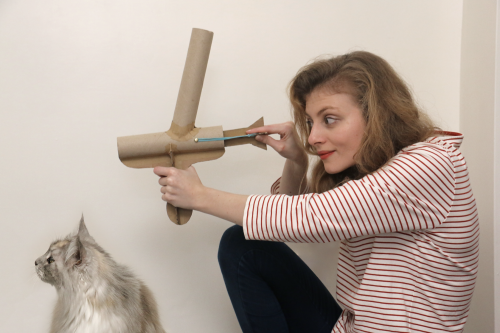
I thought this was such a good idea by Pauline, practical for both the home owner and the cat! An automata would be a good way of showing how this idea would work, so I created a quick cardboard version to work out how to make a crankie-style rolling paper and accompanying scratching cat. It is so roughly made, but it helped me to visualise what I was trying to make. I thought that the rolling wallpaper could be controlled by some sort of handle, and the cat could move using a similar method.
I painted the feather motif on the handle to match the colourful feathers on the inside to hint that this stick is a little bit special!
I started thinking about the decorative element Marie-Claire had mentioned perhaps a hint to the handle looking feathery. It was too tricky to carve directly into the stick so decided to play around with using resin decorative motifs to add onto it. We also attached the plumbing components to the handle and stick which screwed into one another to allow the two pieces of the stick to be rejoined.
Feather's seemed like the best material to use for the tickle element as they are soft and would also have a bit of pliability to them. I found an ethical feather seller called Clare who hand dyes naturally shedded emu feathers. Fascinating fact - emu feathers have two plumes from each quill! I attached the feathers onto a stick so they could be attached to the handle of the walking stick.
Brian got to work on hollowing out the walking stick. He needed to split it up into a few sections in order make a channel inside using a drill and chisels. Then he attached them all back together again! He made a pencil mark on each piece so he knew where each bit connected, otherwise it would have ended up a bit wobbly!
It was so lovely to meet Marie-Claire who came up with the idea of the Grandparent's Friend. I went along to see her with a walking stick and some plumbing hardware to show her what I was thinking to attach the two halves of the walking stick together. We had a great chat and Marie-Claire shared some further ideas on the stick. She described that she had also thought it might be nice if the handle of the stick had a decorative element to hint that this might not just be any ordinary walking stick. This reminded me of the parrot on Mary Poppins' umbrella - a hint of something a little bit magic!
My initial ideas to make this into a real object would be to combine a walking stick and a duster but there are lots of things to think about, how will the duster fit into the stick? what should the duster be made of to make it flexible enough to go into the stick and come back out again? how would the two pieces of the stick fit back together again? I'm collaborating with my dad Brian on this make - he's a joiner so has lots of expertise on making things made of wood.
I've chewed around with this idea on how to portray it, as it's quite open-ended. Having said that, it's very creative, and I've come up with an idea to showcase the happy floating tickle blobs in action!
If you follow along the storyboard, you can see a sad little park with two children sitting bummed out on the bench, as it's raining... However, through some magical sunrays interacting with the raindrops, a magical happy floating tickle blob is born. Upon seeing the sad children, it makes its way down and brightens their day by making them laugh with joy, before finally returning to the earth in the form of puddles that the kids splash in, running off to play at the park happy at last.